Tuesday, January 8, 2019

Another New Year Post


It’s time again for the annual New Year Blog Post—the sixth one I’ve written so that the four of you who read this can be assured of the creepy degree to which I document and hoard memories (as if you ever had doubts). I wrote the first two in New York City, then one in Tennessee, one in DC, one in Mississippi, and now here in New Orleans. The locations are the only way I can keep the years from blurring together. 

2018 started so differently than it ended. A year ago I’d been living in my childhood bedroom at my parents’ house for six months. I was exhausted from incessantly applying to jobs and trying to pay my student loans while not letting myself compromise and give up on waiting for the type of job I knew I wanted. Every day I looked at the websites of a dozen or more universities for new openings, and in January I sent an application to Tulane and promptly forgot about it (I’d long given up on trying to keep track of them all). I started that job at the end of April. Those first 4 months of the year were full of uncertainty and forced patience, and then there were the next 4 months of summer that I spent trying to live between places. I rotated between 6 different houses plant sitting, cat sitting, house sitting, subletting, commuting from Mississippi, and couch surfing (mostly couch surfing), all while looking at over 60 apartments in hopes of finding one that wasn't disgusting (if you haven’t had the pleasure of apartment hunting on a tight budget in New Orleans, it’s sort of like touring the set of horror films every day. You think I exaggerate.) and that I could afford. I will be forever grateful for the friends who let me sleep in their spare bedrooms and on their couches and air mattresses for way too long. I moved into my new apartment in September, and then there were the 4 months of the fall semester when I finally felt like I was doing my job for the first time and learning what advising and living in this city is all about. This was the first time in a decade that I moved to a city that was already familiar and where not every person is a stranger. I’m still not used to it. 

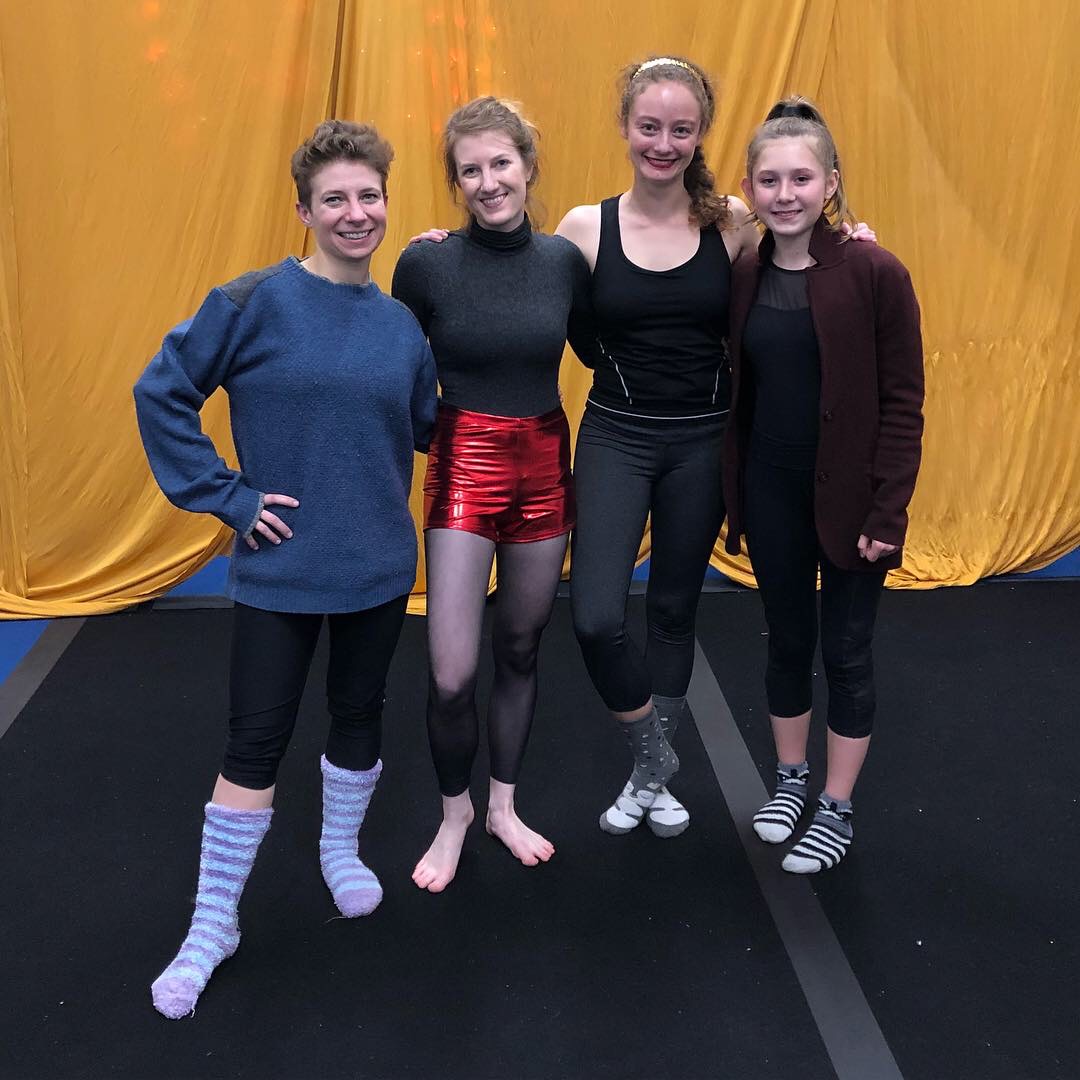
In 2018 I was able to reunite with some of my oldest and best friends. I felt lucky every day for the people I got to work with. I spent a night at my 10 year high school reunion. I published 5 pieces (after three years of publishing nothing). I feasted at Sophie’s dinner parties, toured dead fish collections in swamp bunkers, visited haunted houses, attended Voodoo ceremonies, and watched second line parades from my front porch. Lily turned a year old and also learned how to say my name. I made a pilgrimage to Tennessee and reunited with the first students I ever taught. I interviewed about 35 college applicants and advised over 300 Tulane students and tutored 8 students from 4th grade to PhD programs. I voted in the mid-terms, which felt very different than the last election day. I traveled less than I have in a decade, but I still squeezed in visits to Atlanta, Nashville, and Waco. I stayed for free in a haunted hotel in the French Quarter and pretended to be a tourist. I took my first Spanish class in 12 years and taught my first college class. I ate a lot of tacos and a lot of meatballs and a lot of snowballs and got used to never drinking tap water (which is not an actual rule in New Orleans but maybe should be). I read 81 books and listened to 31 audiobooks. I started taking aerial circus classes and, without really noticing, got stronger than I’ve been since I was 14. I did my first circus performance, and I’m so lucky to have stumbled upon this quirky and delightful circus community that I had no idea existed and feels to me like the real embodiment of this city. 

I turned 29, which feels no closer than 30 than 23 did, really. Sometimes my friends say they’ve started feeling old. To them I suggest joining the circus and performing for an audience in a leotard for the first time since 8th grade—it’s a guaranteed way to cure aging. 

This will be the first spring in 9 years that I haven’t been job searching (whether for a summer job or a full-time one). This will be the first year I work year-round without a summer break. Mostly I hope 2019 is full of feasts and circus tricks and books and publications and new places. Twelfth Night was over the weekend, which I’ve never once thought about before this year. But this time there were king cakes everywhere and the first Mardi Gras parades and people getting excited already, and I went to my silks class and flew around some and felt more like a true New Orleans resident than I maybe ever have. 


Saturday, December 1, 2018

An Ode to Letter Writing


It’s been a while since I’ve posted anything here, but the good news is, I HAVE been writing. There was a two and a half year period after graduate school during which I hardly wrote a word. In part this was because teaching high school consumed every spare minute of nearly every day, but also because I think I just felt defeated. I had a partly finished manuscript that I didn’t know what to do with (This is still true.), and I missed being in graduate school where I was surrounded by people who valued writing the way I did, and I felt unmotivated and incapable of producing anything worth looking at. It was a year ago that I started really writing again. It began with some letters. 

If you know me, you know how much I love letters. The first letters I ever received were in kindergarten. I was a socially anxious kid, miserable at school because, though I loved learning, I was afraid of talking to strangers. My parents tried to help by leaving tiny letters in my lunch box wishing me a happy day at school. My dad called them Happy Day Notes. Each of them featured one of his increasingly elaborate stick figure drawings of me, or the two of us, doing something fun and decidedly unrelated to school—us riding his motorcycle or flying in a fighter jet or, after I started gymnastics, me mid-flight above a balance beam or standing atop a podium with a medal around my neck. My stick figure’s hair was always a long wavy line sprouting from the top of my head, and his stick figure always wore a baseball cap (presumably to make his gender apparent because I don’t think I’ve ever seen him wear a baseball cap). The Happy Day Notes continued throughout elementary school. I cannot say with certainty that they succeeded in making me particularly joyful about being at school as I read them under the lunch table amidst the high pitched chatter of my fellow 6-year-olds and the unmistakable smell of elementary school cafeteria. But they did make me smile. And 23 years later, I recognize that they also taught me a lesson that I did not know I was learning and that my parents did not realize they were teaching—the lesson that sometimes written words have greater meaning than spoken ones. 

By 4th and 5th grade, everyone wrote letters. The bold kids threw paper airplane notes to their crushes when the teacher looked away. The rest of us scratched notes to pass under the table to our friends. Notes elicited giggles and blushes and were full of code names in case they were confiscated. Creative note-folding was a sought-after skill that the popular students learned from older friends and the precocious students learned from library books. (In retrospect, I’m impressed by our late-90s selves for our ingenuity in the days before Youtube tutorials.) Groups of eager students sat in circles at recess to teach each other the intricate origami that would make their letters, and therefore themselves, cooler than a boring folded square. 

Though talking to people was hard for me, writing only ever felt exciting. This is how I became a letter-writing enthusiast. One friend and I wouldn’t settle for our classmates’ punctuation-free scribbles about crushes, and a mere piece of paper wasn’t enough to contain all we wanted to say, so we started writing our letters in a notebook and traded that back and forth instead. We wrote more in those notebooks than I think we ever wrote for our classes, and we filled several of them by the end of the year. When it was my friend’s turn with the notebook, I wrote letters to other classmates and letters that I delivered after school in my gymnastics teammates’ lockers. After finding a way to share the things I was too shy to speak aloud, I never ran out of words to write or people to write them to. 

The volume of notes passed decreased in middle school, and the content of many that were still circulating turned into R-rated confessions and cruel rumors. Gradually everyone started getting cell phones, and by halfway through high school, texts had taken the place of letters and handwritten correspondence became nearly obsolete. My handful of recipients changed and then narrowed, but a small group of us never stopped writing. Our letters were full of novel quotes, song lyrics, dramatic stories, and inside jokes. They were longer than our research papers and more passionate than work we did for any class. We started blogs where we wrote posts in second-person to anonymous “you”s—the letters we couldn’t bring ourselves to give to their recipients because they said things that felt too honest. We transcribed them from scribbled pages and let strangers on the internet read them instead. My written words communicated something far closer to what I wanted to say than I felt my spoken words ever could. 

My best friend, Sam, and I left Mississippi for college—her for Chicago, me for Providence. Though we spoke on the phone every day, we never stopped writing letters. During freshman year, the letters felt like a lifeline to our “real” lives, and we sent them every week or two. After that, our college lives became our real, and busy, lives, and we tried to send letters every month or so instead. Hers often including drawings (she’s an artist), and mine were usually longer. Our letters were essentially journal entries in which we tried to untangle our thoughts and emotions by putting them on paper. I kept a journal as well, and many letters I sent to Sam were lifted straight from my journal pages. I was majoring in fiction writing and spending hours each week working on short stories, but the letters I sent to Sam felt more honest than anything I tried to convey in my fiction. And then halfway through college, I took a creative nonfiction class and realized what should have been obvious but felt shocking instead—that the type of writing in my letters was a legitimate form of creative writing, too, and that it could be more than just a hobby. 

So I decided  to go to graduate school for creative nonfiction writing. My roommate there, Sophie, was a letter writing enthusiast, as well. We would sit opposite each other at the kitchen table, writing memoir chapters for our workshops or editing our classmates essays. Perhaps this was the mid-20-year-old’s version of our teenage blogs—another effort to organize untidy thoughts into relatable experience. Every few weeks, we’d find ourselves together at the table without our computers, writing letters to faraway friends instead. 

And then came the lull after graduate school. There were a couple of full-time jobs and lengthy job searches, both of which drained my time and mental energy. Longterm writing projects lay neglected on my bookshelves. This past fall, I realized I’d written hardly any letters in the past year. So on a whim, I embarked upon a letter writing project. 

Last Halloween, I decided that I would write a letter to a different person for every day of November, mostly as a challenge just to see if I could do it. I made a list of rules for myself—I couldn’t write to the same person twice. I couldn’t write to family members (though I made an exception for distant relatives I have not met in person). I could mail a package instead of a letter, but it had to include at least a small written component. The letters had to be handwritten and mailed (except for one letter I delivered in person). When I came up with the idea, I could not name 30 plausible recipients—people who would not be confused or creeped out upon receiving a letter from me. I realized that it is nearly impossible for a 28-year-old female to ask old friends for their addresses without them assuming they are about to receive a wedding announcement. My mom kindly supplied, “Won’t the guys think you’re flirting with them?” (Would they?) It felt awkward and a little too weird, and I considered giving up on the idea. I made myself send the first letter instead. 


I sent letters to Sam and Sophie and my other closest friends first, which felt easy and familiar. I sent letters to other letter-writing friends who I’ve exchanged letters with before. I mailed brownies and brief letters to friends with birthdays in November. I mailed letters to old friends I haven’t spoken to in a decade, to people I’ve only met once (or in a couple of cases, that I’ve never met in person), to the elementary school friend I shared the notebook with, to the high school friends whose “secret” blogs I used to read, to my former roommates, to the teacher of my first-ever writing workshop, to my writer friends from college and graduate school. I guessed a couple of addresses and sent a couple of extra letters to make up for it. I’d worried that after running out of obvious recipients, the letters may start to feel forced and obligatory to write. None of them did. I sent letters to 25 different cities in 14 different states. 
When I finished the project, I expected to be burnt out and unable to write anything else for a while. Instead I couldn’t stop writing. I started essays that have been in the back of my mind for a while. I started submitting essays I’d been too self-conscious to try publishing. I’ve been more productive with my writing than I have been since completing my MFA program. Most people were thrilled to receive their letters, and (as far as I know) no one was too creeped out. I reconnected with several old friends and have stayed in touch with a few of them. I’ve received a handful of response letters that I did not expect and was irrationally excited by each of them. I wrote them because I wanted to write them, not because I wanted responses. Maybe I instinctively knew that returning to letters, the original source of my writing, would give me the motivation I needed to write anything else. 


If it’s been a while (or, say, a decade) since you wrote a letter, I have a new address I’d be happy to give you. 


Monday, August 13, 2018

The Best Coach I Ever Knew


I found out on Saturday morning that my old gymnastics coach died late on Friday. I was devastated. I hadn’t seen him in probably 8 years, and he hasn’t been my coach in a decade and a half. But my sadness felt urgent and all consuming instead of distant. I didn’t talk about it to anyone except my family (who knew him, too) because I couldn’t talk about it without crying, and because it felt somehow too personal, and mostly because I felt like I had no right to that level of sadness. I spent most of the day alone, just remembering, and when I sat down to write a little commemorative post, I realized I had a lot more I wanted to say. 


I was a kind of impossible kid. I was so painfully shy that I practically couldn’t function around anyone who wasn’t immediate family, and my poor mom had no idea what to do to help. My sister did dance and softball — the regular things all the kids did in my hometown. My mom tried to put me in softball when I was 5 or 6. I spent a miserable season hiding from the ball in the outfield and running in the opposite direction if it flew my way. Then she tried dance class, and then acrobatics, both of which entailed me sitting in her lap for most of each class and refusing to participate in the recitals. Interacting with an instructor I didn’t know was scary, and the thought of an audience watching me was petrifying. And then when I was 6 years old, I watched the 1996 women’s gymnastics team win Olympic gold in Atlanta, and I told my mom that’s it. That’s what I want to do. 

Desperate to prevent me from being a mute hermit, she enrolled me at the only gym in my town, which was a great place for cheerleading and tumbling, but also had gymnastics equipment from the 70s and hadn’t had a competitive gymnastics team in over a decade. I wanted to compete, but we didn’t know of any alternatives, so I was content to be there and learn as many new tricks as possible (without talking to anyone). Months later I was with my mom in Slidell and saw the silhouettes of gymnasts painted in the windows of a strip-mall storefront. I knew there was probably no way I could go to that gym—it was at least an hour from my house, and even then I knew it would be far more expensive than the gym in my town—but I begged her to at least let us go look inside. 

A week later we were back for my first class. I don’t know if I’d ever been so excited for anything. Because of a mix-up by a substitute manager who was filling in for the day, I was accidentally placed in the team class instead of the recreational class—something that probably wasn’t supposed to happen for months. There were two male coaches in the gym—a man named Alex who coached the lower levels and an older man named Victor who coached the older girls (who all looked like Olympians to me). I was both terrified by and in awe of Victor (and his wife, Tamila). I sensed he was legendary before I even knew the details —that he and Tamila were the Soviet coaches of the ’92 Olympic all-around champion, that her medal ceremony was the first time the Ukrainian flag had ever flown at an Olympic Games (the Soviet Union had just fallen), and that they’d immigrated to America just a few years before I walked in that gym (I’m not sure I’d ever heard a foreign accent in person before I heard theirs). To my 7-year-old self, he was superhuman, the embodiment of all my unattainable dreams. 

He and Alex watched me during that first practice. They took me aside and asked me to show them the skills I knew. They spoke quietly in Russian to each other. And by the end of that practice, Victor introduced himself to my mom and said they wanted to invite me to join the team. My mom knew there was no chance she could refuse because for the first time in my life, I wasn't hiding in a corner afraid for anyone to watch me. There haven’t been many single moments in my life I can point to as life-changing. But that was one. 

Victor and Tamila became my coaches after my first competition season, and they remained my coaches for the next 5 years. That meant that I spent more time with them and my teammates than I did with anyone outside of my immediate family. We moved into a smaller, old gym after the lease was up on the original one. None of us minded what it looked like. Their daughter, Tetyana, immigrated soon after and became our choreographer and coach, as well (completing the best team of coaches I ever had). Then came  Tetyana’s husband and daughter, who became my childhood friend. What started as two practices a week quickly became 4 and 5 practices a week for 3 or 4 hours a day, and 8 hour days 5 days a week during the summer. It’s sounds cliche when athletes say their coaches and teammates are like second families. But it’s also true. 

In the gym, the shyness that was so debilitating in every other area of my life melted away. I was hungry for as much as I could get and, to the shock of everyone who’d ever known me, I was thrilled at any opportunity to perform in front of people. (And let me be clear—I was not the best. I was nowhere close to the best. I just loved it that much.) In the gym, Victor was my number one supporter. He saw something in me that I couldn’t see in myself, and he never let me forget it.

Bars was the bane of my existence. I hated the event. I spent agonizing hours in practice and in private lessons trying to get my bar skills up to speed. I was too horrified to try a giant, but Victor told me 400 times that my form was perfect so that I still felt confident enough to keep trying. 

When I got my first rip on my hand from bars, he cut the bloody flap of skin off my palm with nail scissors, placed it in the middle of my palm and closed both of his hands over it. Be proud of this, he said. 

I remember how secretly proud I always felt when we found out the competition order he and Tamila had chosen. Coaches generally strategize when choosing the order their team members compete. The expected high score goes last, and then essentially you work backward from there. But your first competitor should be your steadiest one, the one who you can trust to handle the competition nerves, the one who will set the standard for everyone else. I would never have chosen to go first myself. But there was no better feeling than when they chose me to go first on 2 or 3 events every competition. (Except for maybe the feeling when sometimes I was picked to go last.) There is perhaps no better way to build someone’s self-confidence than to show, for an audience to see, that you have confidence in them. 

When I picture Victor during those years, I remember so clearly how youthful he was. He must have been in his 60s at the time, but everything about him seemed young. I remember how he would catch us in mid-air when we practiced bar dismounts. (Was there anyone else in my life I would have trusted to do that?) He was a small man, but spotting anyone seemed effortless for him. He had the body of a man half his age. He used to swim for miles each morning in the pool at his apartment complex (where he’d bring us to swim twice a week in the summers). It was so important to him that we balance the hard work we did with fun. During our lunch break in the summers, he’d bring everyone to the floor for dodge ball games. (My years running from softballs paid off.) He was soft-spoken and loved to laugh. I don’t recall ever hearing him raise his voice. 

One of my favorite memories is when I did a kip for the first time on the low bar. (If you were never a gymnast and you look this skill up on Youtube, you will not be impressed. But if you were ever a gymnast, perhaps you understand the agony of trying and failing for actual years to get that stupid skill.) It was the Louisiana State Meet at LSU, the last competition of the year. For every competition that year leading up to state, I’d tried the kip, failed, and done it again with him helping me (yes, a huge deduction, but I had to compete the skill, and my score was going to be a disaster no matter what). Except that time, I did it. I could hear my gym’s section of the audience cheering as if I’d just won Olympic gold, and I remember seeing out of the corner of my eye from the high bar that Victor was jumping and running in circles, arms raised, dancing like a maniac. For the entire rest of the routine he danced with the whole crowd watching. He apologized to the judges afterward, then bear-hugged me with tears in his eyes and told me that he hadn’t been this excited when Tatiana Gutsu won the Olympic gold. “I didn’t cry then,” he told me, “but I cry now.” Of course I wasn’t sure that I believe him. But then again…

I was 12 when Victor and Tamila moved away for a coaching job in California. It was one of the saddest goodbyes I’d ever had to say, and I still remember crying as I walked out of that gym with my teammates for the last time that night in December. I went to two more gyms after Victor left. I never stopped loving gymnastics. (I still haven’t stopped loving gymnastics.) But no other coach ever made me feel as confident  or sure as he made me feel. 14 years later, it’s still hard to talk about why I walked away from competitive gymnastics. The simplest thing to say is that I felt like I’d come to the point of picking a route forward. The gymnastics route where there was a single goal (full-paid college scholarship to a college with a good gymnastics program) and no room for error, or the academic one where options felt endless. I couldn’t do both. And I guess something else Victor taught me was that sometimes you have to leave something you love to pursue a different dream. 


In college, I found out that Victor and Tamila had moved back the area and were coaching at one of my former gyms in Mandeville. I remember how hard my heart was beating when I went to visit during a holiday break. I hadn’t contacted them beforehand, and they hadn’t seen me in nearly a decade. Would they even recognize me? When they saw me, they stopped class and pulled me onto the floor to introduce me to the girls’ team—all of them the age I was when they were my coaches. Victor convinced me to warm up with the class, and then he came with me when I tried to make my body remember how to tumble on the tumble track. It was the best gift I could have asked for. They retired not long after that and then moved away with the rest of their family. I’m so grateful for seeing him that last time. 

The actual skills Victor taught me were secondary to the ways he changed me as a person. Victor was one of the most accepting people I’ve ever known. Everyone, no matter their background, skill level, age, or size, was welcome in his gym. He taught me quiet confidence and pride and how the things we work hardest for should always be things we love. He taught me about perseverance, discipline, and most everything that has helped me have any degree of success in anything I’ve done since. 

There’s been so, so much in the news for the past couple of years about USA Gymnastics. Child abuse and molestation and eating disorders and permanent emotional damage. It’s hard to watch as more and more people are sharing more and more of these stories, and it’s heartbreaking to see the world learning to affiliate the sport with abuse like this. It’s hard to know that parents have not allowed their little girls to start or continue gymnastics because they associate it with these cases. I wish I could tell them that there’s an awful lot wrong with elite gymnastics and the national team setup, and that there are a lot of terrible people affiliated with this sport, and those are rightful things to be wary of. But I also want to tell them that’s not all the sport is. Let me tell you about my childhood gym and my coach. This is what gymnastics is supposed to be. This is what a coach is supposed to be. 


I’m thinking of Tamila, Tetyana, Lana, and their family tonight, and I’m so grateful for these memories of Victor. I’m lucky to have known him. 


Tuesday, July 17, 2018

The High School Reunion Blog You All Knew Was Coming


Because I certainly can't go to my high school reunion and not write about it. 


A few years ago, my high school classmates started mentioning our ten year reunion in our class Facebook group. There was talk of dates and locations and who planned to go and who was too far away. I think I was in New York City the first time it was mentioned. And then it came up again when I was in Tennessee. And then actual plans started to develop when I was in Washington, D.C. No matter where I was in the country, I knew from the first time it was mentioned that I would go. But I could never quite articulate why. 

I did not love high school. Or rather, there were aspects of my high school years that I loved, but the actual school bit was, for the most part, not one of them. My high school was the stereotypical southern variety that cared a lot about labels. (Think Friday Night Lights. Exactly that.) Aside from being one of the “smart kids” (which included all the students who signed up to take the few honors and AP classes the school offered), I was never part of a built-in group the way my sister always was. I was friends with individuals but marginal to their cliques. I knew people, because when you live in a town with four elementary schools that feed into one middle school and high school, you inevitably know people. But I wasn’t popular. I had a best friend who was (okay, is) far more charismatic than I will ever be, so some people saw me only as a sidekick. I wasn’t invited to the Friday night parties (and wouldn’t have gone to them if I had been). Instead my few close friends and I were sitting on top of cars in empty parking lots, and making movies, and writing secret blogs that only strangers and each other would read. I was voyeuristic and painfully aware of things. And though I wanted people to know who I was, I felt incapable of actually talking to them.

If other people don’t identify us the way we identify ourselves, it can feel like that identity doesn’t exist at all.

When I got into college (which was not a given at my school), part of me wanted people to know it because it would mean that maybe my peers would finally identify me the way I wanted to identify myself. (Smart, but also determined. Resilient. Bold.) For the most part, this did not happen. Very few students or teachers had ever heard of my college. Very few people understood why I wanted to go so far away. Aside from the handful of friends and teachers who knew me well, it went largely unnoticed. Though I left high school feeling recognized by the people I was closest to, I suspected that to everyone else, I was the very definition of a wallflower. 

When I graduated from college, my mom begged me to let her ask our town’s newspaper to publish something about it. To our knowledge, I was the first person from my high school to ever attend any Ivy League school, and I was about to start a degree at a second one. The thought of a public announcement felt humiliating and self-aggrandizing, but at the same time, I felt like, yes, I did a cool thing that I’m proud of, and if there’s even a chance that someone else can see it and realize that they can also do whatever cool thing they’ve always wanted to do that no one else has told them they can do yet, then it would definitely be worth me feeling self-conscious. A small part of me also wanted that validation. Look town, I’m not a wallflower anymore. 

But the newspaper wouldn’t publish it. They said it wasn’t newsworthy. All those years later, and I still felt invisible in my hometown. What if I could only be myself a thousand miles away? What if I could only be myself in cities where no one knew me? How had I gone from a person incapable of talking to strangers to being a person who only felt comfortable around strangers? Can you spend 18 years in a place and still feel like you don’t belong there? (The answer to this is yes, you absolutely can.) 

Years later as our reunion date got closer, I saw so many negative comments on social media. Why would I want to hang out with people I didn’t even like ten years ago? I already see the people I want to see from high school, so why would I want to go pretend to care about anyone else? I’m not interested in watching people stand around with their old cliques. I understood the comments, but at the same time, I couldn’t relate to them at all. I’m a sentimental person, a memory hoarder who perpetually exists half in the past. When I tried to persuade friends to come with me, they’d ask why I wanted to go in the first place. I could never articulate a good answer. Because it has never occurred to me to pass up an opportunity to reminisce with other people I wanted to say, which is true but not  the full answer. Maybe because I’m both the same person I was in high school and a different person entirely, and I want to see the ways in which that’s true for everybody else. Because I don’t have to be best friends with someone to have memories of them that I’d like to hang onto. Because I no longer need affirmation from anyone there. Because there are very few times in life when we can so clearly measure the way we’ve grown as people than the times when we can throw ourselves back into a group of acquaintances who knew us before puberty. Because sometime in the past ten years, I learned how to talk to strangers. (The only way to cure social anxiety is to move to four cities over ten years where you don’t know a soul.) 

But also there’s this. It took me six years of higher education, two years of teaching at selective high schools, and these past couple months of advising college students to fully realize how thankful I am to be a product of my high school. I’ve seen the alternative, and at the time it was what I desperately wanted. But in retrospect, I’m thankful my high school experience wasn’t stressful and that the only pressure I felt was from myself. I like that I had to find my own friends instead of having a built-in friend group. I like that I went to school with all kinds of people who were different than I was. Despite how harsh a critic I am of Mississippi public education, I also know that I wouldn’t trade my experience for another one, because it’s part of my identity, too. 

And so I went, with a couple of my (still) best friends who I’d spent months trying to coerce. And I don’t mind if it’s melodramatic to say it lived up to every expectation I had for it. I have never seen such collective and genuine enthusiasm from an entire group about seeing old acquaintances, regardless of whether the individuals were friends in high school or not. I had conversations with people I’ve “known” for 15 or more years but never had a one-on-one conversation with. I have never seen so many people connect with each other across still-in-tact friend groups and decade-old cliques and teenage animosity. If this was what high school parties were like, I hate I missed them. This reunion held none of the emotional weight and intensity that my college reunion did (see my college reunion post), maybe because it’s not a time in my life I would want to live again. Instead it was the less complicated kind of fun where I watched my former classmates dance together in a way that our teenage self-consciousness would probably have prevented the last time we saw each other. 

My general assumption in social situations is that I will know people who do not know me. But people knew me that I did not expect to, which made me wonder if I might have been wrong about how people saw me all those years ago. Who was I to you back then? I wanted to ask, but there are limits to just how weird I’m okay with being viewed in public. 

I did not mention that I write. I did not mention my college or what I did in grad school. That’s not who I am to these people, and I’m fine with that. I mostly asked questions and learned about the cool things everyone is doing and all the places they’ve traveled and met their significant others and looked at pictures of their kids and reminisced and felt weirdly proud of everyone for still liking each other this much. And then the reunion ended but everyone was having too much fun to stop, so we went to a bar and did the whole thing again when even more former classmates showed up. Letting people surprise you is always worth it. Spending a night feeling grateful for a shared past is always worth it. 


                                                  *Last two photos belong to Brittany S. 


Sunday, December 31, 2017

2017 Recap

I haven’t posted much here in 2017, not because I wasn’t writing, but because for the first time since grad school, I was writing for more than the three of you who read this, and most magazines and literary journals won’t accept work that I publish here first. Despite all the disappointments of this year, writing more is one thing I feel really good about. 

This is the 5th New Year’s post I’ve written in which I reveal the obsessive degree to which I document and hoard memories. The years have started to blur together now, and it’s the changing locations that help me to keep track of a timeline. 

2017 was a blur of emotional extremes. There was the inauguration, the resulting fear, shock, and anger. There was the birth of my niece, train rides, and friend reunions. I spent half the year working in D.C. and half the year in Mississippi, where I never expected to be for quite so long and where I’ve been unexpectedly content. I moved out of one of my favorite apartments and away from one of my favorite cities—my 8th cross-country move. I met literary agents in New York City, read my work to strangers in Baltimore, climbed a mountain in Virginia, and hunted ghosts in Gettysburg. I participated in the Women’s March, the Climate March, the Immigration Protest, and so many other empowering and hopeful gatherings. I spent three surreal days at my 5 year college reunion. I saw the partial eclipse, fall colors in Canada, and snow in Mississippi. I learned how to hold a baby without being horrified and went on more field trips than I can count with the coolest 11-month-old on Earth. I spent 215 hours (including 7 nights) on trains, 41 hours on buses, and slept in 8 states and 2 countries. I mailed several hundred brownies/cookies and mailed a letter every day for a month. I interviewed 23 college applicants and wrote what feels like 4 million cover letters. I read 55 books. 

I turned 28 last month, and though I’m not sure how 28 is supposed to feel, I don’t think I feel it. If it’s supposed to feel grown up or successful or accomplished, I don’t feel it. If it’s supposed to feel stable or settled or maternal, then I definitely don’t feel it—a fact I’m perfectly fine with. What it does feel like is that I make very good brownies, and like I’ve gotten much better at packing suitcases, and

like I’m physically stronger than I look, and like I’m not as bad at talking to strangers as I once was. I count these as victories. 

Right now 2018 feels very uncertain. I don’t have a plan, don’t know where I’ll be in a month. But that has stopped feeling like as much of a problem as it once did. There are so many things to be excited about. 


Tuesday, October 31, 2017

Ghost Walk

Halloween (and fall in general) always makes me miss Providence, and my favorite Halloween in Providence was the one I spent writing my first-ever attempt at journalism for my first-ever creative nonfiction class. And even though reading my writing from 7 years ago is fairly painful and makes me cringe, I think I'd still credit this assignment as one of the main reasons I decided to pursue nonfiction for the rest of college and then grad school, and also the reason I want to do ghost tours in every city I visit. I'm so glad I found it hidden away in my email. 

Google tells me that Rory Raven lives in Salem, MA, now, and if any of you are ever there for a visit, I hope you'll find him and take a tour. 
Providence


Ghost Walk

It’s the afternoon before Halloween, and the crowd for the Ghost Walk is large. Parents bring costumed children, teenagers come in couples, and one woman’s brought her poodle. Rory Raven sells tiny orange tickets to each person that approaches. Shortly after 3:00, the crowd’s grown to about fifty, and Rory begins.  

Brown's Halloween midnight organ concert
His voice resonates.  A woman behind me says, “He’s such an interesting orator,” which I think is an understatement. He has the rolling inflections of an auctioneer, but with immaculate pauses. He’s persuaded these people to care about something that they don’t even realize they never cared about before. This is his performing voice. This is how he talks to his audiences as he leads them on Benefit Street and as he stands on stages before them in theaters around New England. 
This isn’t the voice he uses when he subtly tells the woman with the baby stroller not to worry that she could only find five dollars for her ticket instead of eight. It’s not the voice he uses to talk to the couple of women on the tour that he knows personally, joking when they pose on either side of him for the camera (“I rarely show up in pictures.”). It’s not the voice he uses with me in the coffee shop a few weeks later, offering me part of his cookie and telling me about the book he’s currently reading. But I wouldn’t consider one voice fake and the other real. I would say that Rory Raven knows how to compel a crowd to listen.  
He begins the tour by saying that others shared these stories with him, and that’s how we should take them –- as stories. “And one of these stories is the product of my own imagination,” he adds, “but I’m not telling you which one. He doesn’t, even when I ask him later.  
“People always do this. I said I wasn’t going to tell you which one. I didn’t say I’d tell you later,” he laughs. 
“But I could look up all of the stories and know it was the one I couldn’t find, right?”
He shrugs, “Well. I guess you could.” 
I don’t look it up, because part of the intrigue is not knowing. It’s this knowledge of how to best captivate an audience that makes Rory’s tour so effective.
The Ghost Walk takes place almost entirely on Benefit Street, starting with stories of Edgar Allen Poe and Sarah Helen Whitman in the Athenaeum and featuring roughly a dozen more stories and locations including Sarah Helen Whitman’s house, the house in H.P. Lovecraft’s “The Shuttered Room,” and a cemetery.  Rory walks ahead of the crowd and waits patiently for everyone to catch up before he begins a story. His speech seems far from scripted, and he frequently includes bonus information (“…and that’s the story of the Mansion Hotel. By the way, Geoff’s next door there –- best burger I’ve ever eaten. I’m serious everyone. Go there.”)  
He ends the tour by saying that he has one more story and that he can prove it’s true. It’s the story of a disturbed teenage girl whose family locked her in the upstairs room of their house on College Hill. One day the family opened the room to find the girl missing, though there was no way for her to get the key. He says no one ever knew how she escaped. He pauses and invites the audience to “Come closer. Closer.” He pulls a skeleton key from his pocket and places it flat on his palm. The audience gasps as the key slowly turns in his hand, seemingly by magic. The crowd applauds as Rory wishes everyone a Happy Halloween and tells them that Cable Car next door has coffee and a bathroom if anyone needs them.  

Later, I ask Rory about his childhood and how be became interested in all of this. I might have expected a back-story equal in eccentricity to the man in front of me, but Rory presents his childhood as nothing out of the ordinary. He was born and raised in Rhode Island and grew up thinking he wanted to be an English teacher. “I would have written those unintelligible papers with lots of subtitles,” he says without remorse for having missed the chance.  
His family was Irish-Catholic, which he feels caused his love of storytelling. He recalls getting sick as a child and having to spend the week in bed. “My sister would come into the room and read me Edgar Allen Poe stories in the dark.”  
But he doesn’t consider himself religious. As he got older, he grew skeptic of his family’s Catholic beliefs and went through a period in his twenties when he was
a devout atheist. He smiles at this memory and says that, “At forty-one, I’ve mellowed.” 
He attended Bard College and intended to major in literature, but ran out of money and came home after one year. For the next several years he took occasional courses at various schools before ultimately deciding that college wasn’t the path for him. He calls himself self-taught, saying, “I never worked well in classrooms. I wish I had figured that out earlier.”  
The tours began after he went on a similar tour in Newport and decided that Providence should have one, too. He started asking people for stories, hung a few posters around the city, and started telling the stories to whoever showed up. The Ghost Walk started in 2000. His career as a mentalist started four or five years before that. It’s hard to say exactly when the point was that he started performing for real audiences instead of just for friends at parties. When I ask exactly what a “mentalist” is, he laughs and says that the term is slowly starting to catch on in America because of the TV show. “Except people expect me to fight crime,” he adds.  
He was about 25 years old when he got interested in the idea of being a mentalist. “You know, at twelve, you get a magic set,” he says, and then pauses, “—or maybe you didn’t, but the twelve years old guys did. And they’re interested in it for a little while. Well in my twenties I came back to it, but with more interest in the mental aspect.”  
I ask the obvious question, “So you’re not claiming it’s real?” 
“No. Am I a psychic? Of course not,” he dismisses the possibility. “It’s a theatrical performance.” 
“So how does it work?”
“It involves a lot of different things –- having a good memory, being good at reading people, different kinds of psychology, some stage magic.”  
“And you’re upfront about this.”
“Oh yeah, I’m not trying to lie to anyone. Of course, they don’t always believe me. I had one lady tell me that I’m the ‘other kind of fake.’ I said, ‘Oh really? And what kind of fake is that?’ She said, ‘The kind who says he’s not a psychic but really is and won’t reveal it.’” He laughs like he’s never heard something so absurd. “Now why would I do that?” 

Rory’s attitude is a huge contrast from those who would call themselves believers in “mysticism.” One such man is a retired Brown professor whose special focus is mysticism and occult magic. We met in his office in the basement of the Slavic Studies department where he told me about leading numerous Brown students in activities like crystal ball gazing and card reading as well as performing exorcisms. Though he himself has never seen “a spirit” (though he has seen the “swirling fog” where another person saw a full ghost of a woman), he does believe that others see them.  
When I bring up Rory Raven, he smiles like I’ve mentioned an idol. “What an elegant and powerful man,” he says sincerely. “Yes, he’s a very interesting man,” he adds as an afterthought, “though we’ve never met in person.” 
I ask the professor what the difference is between someone who performs as a mentalist and someone who actually believes it. He says, “There’s a lot of overlap between a genuine occultist and a mentalist though neither wants to acknowledge it.” Both start with empathy-– sensitivity with people, picking up cues, things like skin tones, body language, and muscle tension. “So a spiritual counselor uses the same skills that Rory Raven would use to read your mind.”  
“Rory Raven has worked hard to cultivate his abilities, both on stage and off, to a level that most people did not think could be done. He’s a much more impressive presence than I am,” he says. I feel that this is a pretty profound statement considering that it comes from a man who has never met Rory, looks like a six and a half foot tall Santa Clause, and talks casually about the exorcisms he’s performed.  

Providence Athenaeum 
I ask Rory how many of the stories from the ghost walk he believes. “Well, I guess all of them. I mean, none of it’s fibs.” Of course some of the stories are spun in a specific way, and he tends to go with the traditional oral telling of the stories instead of only telling the facts that can be proven. I ask if anything strange has ever happened on the tour and he says no, “because it’s not that kind of tour. It has to do with the tone you set, and on the tour I’m not talking about orbs and things.” 
I know what he means because the Providence Ghost Tour -– the “other ghost walk”— does just that, happening at night instead of the afternoon, and lead by a guide who carries a lantern and an EMF (Electro Magnetic Field) detector (which the guide is quick to warn is not entirely accurate and has been known to be set off by text messages), and encourages the audience to take pictures of the tour sites because of the possibility of finding orbs later. The tour charges eighteen dollars instead of Rory’s eight dollars, is run by a team of guides, and seems to be a sore subject for Rory who smiles and says, “Yeah, it’s the rip-off tour,” but won’t say much more on the subject.  

When a South Carolina publisher contacted Rory and asked if he would write the stories from his tour, the result was his first book Haunted Providence: Strange Tales from the Smallest State.  
They contacted him about the second book and asked if he would write about the mafia.  He told them no –- because he has no interest, but also because “they’re still around. I told them, ‘I will if you come start my car every morning.’” So instead the second book, Wicked Conduct: The Minister, the Mill Girl, and the Murder that Captivated Old Rhode Island, is about Sarah Cornell -– a girl from Fall River who was found dead and pregnant with what was thought to be the child of a Methodist minister in Bristol. “It was the OJ case of the 1830s,” Rory says.  
The third book, The Dorr War: Treason, Rebellion, and the Fight for Reform in Rhode Island, was released just a few weeks after our interview. It’s about the 1840s voting rebellion and Thomas Wilson Dorr, who Rory calls “one of the most remarkable heroes in Rhode Island history,” adding, “You know, there’s nothing more scary than politics.” 
“So you are still doing English, just not exactly how you planned,” I say.  
He agrees, “That’s true, I am, but I’m also doing history in a sort of popular media way -– I’m not an academic historian.”  

St. John's Cemetery in Providence

Rory love what he does. He tells me that his touring has enabled him to travel to places he otherwise never would have seen. At first he would spend days online looking for small theaters in New England. Now he’s been to theaters all over the Northeast, and he even traveled to Istanbul where a friend invited him to do a show. His favorite venue might be the Haskell Opera House in Derby, Vermont, where the stage is in Canada and the audience is in the U.S. “I just want to keep touring, maybe in some bigger houses. I’m not looking for a Vegas act or NBC show. I’m happy doing this.”  
He already has an idea for his fourth book. He wants to write about the Harvard chemistry professor, John White Webster, who was accused of murdering a man and hiding his body in a waste-disposal vault at the medical school. Rory said this was so publicized when it happened that when Charles Dickens came to America on a lecture tour, he asked to see the room where the body was found.  
“I’ve never heard that story before,” I say. “It’s weird how the media can be so obsessed with something and then just forget it.”  
“That’s what’s fascinating,” he says. “It makes me wonder what we’re obsessed with now that will go away in one hundred years.”  

I close my notebook at the end of the interview and ask if there’s anything he’s willing to share that I haven’t asked about.  
He shrugs, “I mean, do you want me to read your mind?” 
I laugh and agree. This is a trick I’ve seen him do in online videos, but it’s far easier to accept things as simple tricks when they’re performed on a stage than when they happen in front of you in a coffee shop.  
He pulls a small pad of paper and pencil out of his bag and asks me to think of a number between one and one hundred.  
“Picture the number. Picture it in front of you and imagine that you’re pushing it towards me.” He stares directly in my eyes and writes something on the paper before handing me the pencil.  
“What was the number?” 
“Twenty-four,” I tell him.  
“Why twenty-four?”
“It’s my favorite number.” 
He nods his head. “So there was some significance behind it,” he says thoughtfully before he lays the pad in front of me on the table.  
I look from the twenty-four he’s written to him, both of us smiling and silent.  
“Well,” I finally say. “No explanation?”
“No,” he says pleasantly.  
“Do it again,” I say.  
He shakes his head, still smiling. “No.” 

After the interview I ask him one follow-up question in an email. “Raven’s not your real last name, is it? Or will you never confess?”  
In true Rory Raven style, he sends the reply, “You might say,’ When asked such a question, he laughs darkly and deftly changes the subject.’  Have you noticed the ants are getting larger these days?” 

Providence Athenaeum, aka most beautiful library ever